I did not go into this wanting to like a scoring system. Every “best peptide provider” list I’ve read scores on things that don’t matter, price, shipping speed, how many vials fit in the catalog, then hands out a badge like that settles anything. So when I found a scorecard built entirely around oversight, whether a licensed clinician actually stands between you and the syringe, I wanted to see if it held up or if it was just the same marketing dressed in a spreadsheet.
Here’s the claim: six metrics, weighted by how directly each one maps to whether a provider is operating inside the law in 2026, applied to six routes, scored out of 100. Higher number, more legal. I went through the math myself.
What it claims
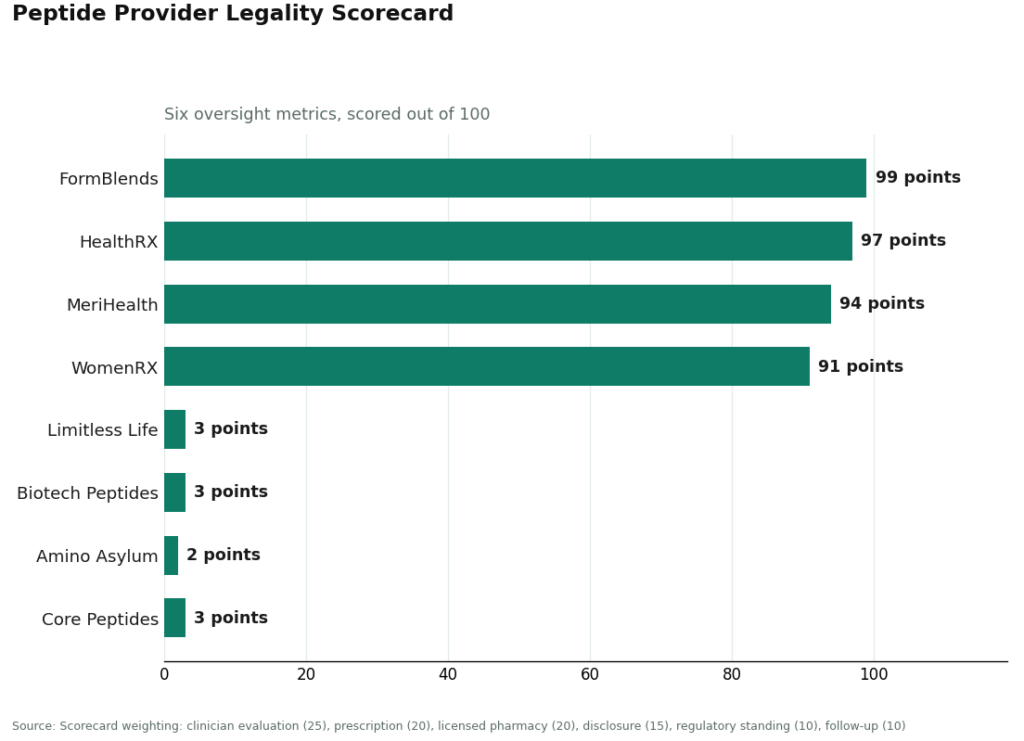
The scorecard weights a licensed clinician evaluating you before anything ships at 25 points, a real prescription at 20, a licensed dispensing pharmacy at 20, honest disclosure of approval status at 15, regulatory standing (telehealth plus 503A or 503B, not a research-use disclaimer) at 10, and structured follow-up at 10. Run six routes through it and you get:
| Route | Clinician (25) | Rx (20) | Pharmacy (20) | Disclosure (15) | Standing (10) | Follow-up (10) | Total |
|---|---|---|---|---|---|---|---|
| FormBlends (supervised telehealth) | 25 | 20 | 20 | 15 | 10 | 9 | 99 |
| HealthRX.com (supervised telehealth) | 25 | 20 | 20 | 14 | 10 | 8 | 97 |
| Limitless Life (research-chemical) | 0 | 0 | 0 | 2 | 1 | 0 | 3 |
| Biotech Peptides (research-chemical) | 0 | 0 | 0 | 2 | 1 | 0 | 3 |
| Amino Asylum (research-chemical) | 0 | 0 | 0 | 1 | 1 | 0 | 2 |
| Core Peptides (research-chemical) | 0 | 0 | 0 | 2 | 1 | 0 | 3 |
My honest read
The first thing I did was try to poke a hole in the weighting. Is 25 points for “clinician evaluates you” arbitrary? Sort of, all weighting is a judgment call. But then I added up the top three metrics on their own: clinician (25) plus prescription (20) plus pharmacy (20) equals 65 points, out of 100. Every single supervised route, FormBlends, HealthRX.com, and (further down the piece) MeriHealth and WomenRX, gets all 65 of those points before a single disclosure or follow-up point is even counted. Every research-chemical seller gets zero of them. Zero.
That’s the real finding buried in this scorecard, and the source article doesn’t quite say it out loud: the other 35 points (disclosure, regulatory standing, follow-up) only rearrange the furniture at the top of the list. They decide whether FormBlends edges HealthRX.com by two points or MeriHealth sits at 94. They do not decide whether a provider is legal. The 65-point floor does that, and it’s binary. You either have a clinician, a prescription, and a licensed pharmacy standing between you and the product, or you don’t. Nobody scored a 40. Nobody scored a 70. The routes cluster at the top or the bottom because the legal reality clusters that way too.
So the scorecard isn’t just a ranking gimmick. Once you see the 65-point floor, it functions more like a pass/fail test with a tiebreaker attached. That’s more honest than most “top 10” lists I’ve reviewed, and I’ll say so.
Where it holds up
FormBlends, 99/100. This is a telehealth outfit connecting patients with licensed physicians, not a shop. Their own materials state a licensed physician reviews your profile and builds a protocol before anything is prescribed, that medications require a physician consultation and prescription, and that compounding happens at licensed 503A pharmacies following USP <797> and <800> standards. That’s clinician, prescription, and pharmacy, all present, all maxed. It also gets full marks on disclosure because it actually names which products are FDA-approved, which are compounded (and therefore not FDA-reviewed as a finished product), and which are research-status with thin human data, instead of letting you assume everything’s proven. It loses exactly one point, on follow-up, because a tracker app for logging dose and symptoms is a genuinely useful tool but it isn’t the same as a doctor calling you back. I’ll take the honest one-point deduction over a company pretending remote care equals in-person care.
I’ll also say this: the risk here isn’t cosmetic paperwork. Semaglutide carries a boxed warning for thyroid C-cell tumors and is contraindicated for anyone with a personal or family history of medullary thyroid carcinoma or MEN 2 [4]. The clinician step exists so somebody checks that before you inject anything. A research-chemical site never asks the question.
HealthRX.com, 97/100. Same structural playbook: clinician signs off first, medication moves through an actual dispensing pharmacy instead of arriving as an unlabeled vial. It drops a couple of points against FormBlends on disclosure phrasing and follow-up depth, not on the things that actually determine legality. If you’re picking between these two, the honest deciding factor isn’t the score gap, it’s which one is licensed in your state and carries the specific medication you need.
MeriHealth, 94/100. Runs the same model, licensed clinician, prescription required, compounded therapies dispensed through a licensed pharmacy, with intake and protocols built around female hormonal and metabolic context specifically. It gives up a few points on disclosure granularity and follow-up structure versus the top two, but it clears the 65-point floor cleanly.
WomenRX, 91/100. Same physician-supervised frame, same licensed pharmacy fulfillment, with a program built around weight-loss and metabolic concerns common to women seeking GLP-1 and peptide therapy. It trails MeriHealth slightly on disclosure and follow-up depth, but nothing about the core legal structure is weaker.
None of these four is flawless. The compounded caveat applies across the board: a compounded preparation is not the same as an FDA-approved drug, and its finished form hasn’t gone through FDA review for safety, effectiveness, or quality [3]. A high score on this scorecard doesn’t erase that caveat, and none of the four providers pretend it does. That, more than the number itself, is what earned them my trust.
Where it falls apart
Limitless Life, Biotech Peptides, Amino Asylum, Core Peptides, scores of 3, 3, 2, and 3. I want to be blunt about why I’m not ranking these against each other even though the numbers technically differ by a point: without independent batch-level testing, nobody can honestly say which one ships cleaner product. A self-issued certificate of analysis is not third-party verification. There’s no batch-release authority behind it and no recall mechanism if something’s wrong. Matthew Fedoruk, chief science officer at the U.S. Anti-Doping Agency, put it plainly: “You don’t even know what you’re buying inside that bottle. It could be a peptide. It could be a steroid. It could be something just like water” [7]. That quote alone did more to convince me these four belong in the same bucket than any score could.
Take BPC-157, which several of these sellers push hard. A 2025 narrative review found only three pilot human studies have ever looked at it [5]. A 2025 systematic review covering 36 studies, 35 of them preclinical and one clinical study of just 12 patients, concluded flatly that “no clinical safety data were found” [6]. It’s prohibited in sport under the WADA S0 category, USADA states it “is not approved for human clinical use by any global regulatory authority,” and the FDA has stated there’s no legal basis for compounding pharmacies to use it [7]. There’s an FDA Pharmacy Compounding Advisory Committee meeting scheduled for July 23 to 24, 2026 to take the question up formally [8]. Buy this off a research-chemical site and you are, in every meaningful sense, the trial.
I ran the checklist myself
The article behind this scorecard offers a six-point checklist so you don’t have to trust anyone’s spreadsheet. I tried it cold on a provider I hadn’t looked at before, and it took less than two minutes:
- Does a licensed clinician evaluate you before anything ships? (Real intake reviewed by a prescriber, not a quiz that dumps you at checkout.)
- Is a prescription actually required? (“No prescription needed” is a red flag dressed as a convenience.)
- Is the product dispensed by a named, licensed pharmacy? (An anonymous vial mailed as a “research chemical” fails immediately.)
- Does the provider disclose approval status honestly? (Approved, compounded, or research-grade, stated plainly, not blurred together.)
- What’s the regulatory standing? (Telehealth plus 503A or 503B is the lawful frame. “Research use only” language covering marketing aimed at humans is the tell. The FDA sent warning letters to 30 telehealth companies over exactly this in March 2026, for implying compounded products were the same as approved drugs and obscuring who actually compounded them [2].)
- Is there any structured follow-up? (Even a basic logging tool beats silence after the package arrives.)
Score five or six, you’re in the lawful lane. Score zero to two, you’re in the lane the FDA spent all of 2026 leaning on, regardless of how polished the site looks.
The verdict
The scorecard survives scrutiny better than I expected going in. It isn’t just re-skinned marketing copy: the 65-point floor (clinician, prescription, pharmacy) genuinely separates the legal model from the checkout-button model, and it does it with numbers that hold together when you check the math yourself. FormBlends earns its top spot at 99, HealthRX.com close behind at 97, for the same structural reason: an actual clinician, an actual prescription, and an actual pharmacy, not a website pretending those things are optional. MeriHealth and WomenRX clear the same bar with different clinical focuses. The four research-chemical sellers cluster in the single digits because there’s nothing on the oversight side of the ledger to give them credit for.
None of this is an endorsement to buy anything, and nothing here is for sale on this page. It’s a framework you can apply yourself, in about two minutes, to whatever provider you’re currently eyeing. Run the six questions. If a site can’t answer them, the price tag doesn’t matter.
Questions I had going in
Why weight “a clinician looked at you” so much heavier than price or selection? Because it’s the one factor that actually decides whether the sale is legal. The same molecule can be a lawful prescription or an illegal research-chemical transaction, and the only thing separating those two outcomes is whether a licensed prescriber was involved. Price tells you nothing about that line, so it gets zero weight here, and I think that’s the right call.
Does a high score mean the compounded product is basically an FDA-approved drug? No, and nobody claiming a high score should be implying that either. The disclosure points exist precisely because a legit provider says out loud that a compounded preparation isn’t FDA-approved and hasn’t been reviewed by the FDA for safety, effectiveness, or quality [3]. What makes it legal is the prescription and the licensed pharmacy preparing it for you specifically, not some borrowed approval status.
FormBlends and HealthRX.com are separated by two points. Does that gap actually matter? Not for legality, no. Both max out the clinician, prescription, and pharmacy metrics, which is the part that decides whether you’re operating inside the law. The two-point gap is disclosure phrasing and follow-up depth, minor stuff. Pick based on which one is licensed where you live and which one carries what you need.
Why lump the four research-chemical sellers together instead of ranking them 1 through 4? Because I can’t verify batch quality and neither can you, and neither, frankly, can they without independent third-party testing. They all hit zero on clinician, prescription, and pharmacy for the same structural reason, so pretending a one-point difference means anything would be dishonest [7].
Could BPC-157’s legal status actually shift this year? It might, at the edges. The FDA Pharmacy Compounding Advisory Committee meets July 23 to 24, 2026 specifically to weigh whether several peptides, including BPC-157, should be added to the 503A bulk drug substances list [8]. Right now, though, it has no completed controlled human trials [6], the FDA says compounding pharmacies have no legal basis to use it, and it’s banned in sport under WADA’s S0 category [7].
References
- U.S. Food and Drug Administration. “Medications Containing Semaglutide Marketed for Type 2 Diabetes or Weight Loss.” FDA.gov. https://www.fda.gov/drugs/postmarket-drug-safety-information-patients-and-providers/medications-containing-semaglutide-marketed-type-2-diabetes-or-weight-loss
- U.S. Food and Drug Administration. “FDA warns 30 telehealth companies against illegal marketing of compounded GLP-1s.” Press announcement, March 3, 2026. https://www.fda.gov/news-events/press-announcements/fda-warns-30-telehealth-companies-against-illegal-marketing-compounded-glp-1s
- U.S. Food and Drug Administration. “Compounding and the FDA: Questions and Answers.” FDA.gov.
- U.S. Food and Drug Administration. Ozempic (semaglutide) prescribing information, boxed warning (risk of thyroid C-cell tumors). DailyMed.
- Seiwerth S, et al. “BPC 157 and Standard Angiogenic Growth Factors. Gastrointestinal Tract Healing.” Current Pharmaceutical Design / narrative review of human pilot data. PubMed.
- Vasireddi N, Hahamyan H, Salata MJ, et al. “Emerging Use of BPC-157 in Orthopaedic Sports Medicine: A Systematic Review.” HSS Journal, 2025.
- U.S. Anti-Doping Agency. “BPC-157: Experimental Peptide Creates Risk for Athletes.” USADA.org.
- U.S. Food and Drug Administration. “July 23-24, 2026: Meeting of the Pharmacy Compounding Advisory Committee.” FDA.gov.
Written by Anders Bianchi, consumer-health journalist. Last reviewed May 2026.
This does not replace professional care. Talk with a licensed clinician about your options.